
The RAGE 9 engine is the technology Rockstar is using to build GTA VI, and if the leaks and patent filings are anything to go by, it is going to make every open-world game before it look like a rough draft.
I say that because I have been following Rockstar games long enough to know when the engine is doing the heavy lifting. I still remember standing on a street corner in Liberty City during GTA IV in 2008, not playing, just watching. A guy got out of a cab, paid the driver, walked into a building. Two people argued nearby. Rain started and people raised their collars. Nothing I triggered. Just a city living on its own.
That feeling came from the RAGE engine. And with GTA VI, RAGE 9 is supposed to push it so far beyond what RDR2 achieved that the gap feels as large as GTA III to GTA IV.
Here is what the RAGE 9 engine is actually expected to do, how Rockstar built up to this point, and what it means for GTA VI.
| ⚠️Disclaimer: Rockstar Games has not officially confirmed the name “RAGE 9” or publicly released engine specifications for GTA VI. Everything in this article that is specific to RAGE 9 is based on community leaks, Rockstar patent filings, and reporting by outlets including Rockstar Mag and The FPS Review. The RAGE history sections covering GTA IV, GTA V, and Red Dead Redemption 2 are well-documented and verified. We will update this article as official information becomes available. |
What is The RAGE 9 Engine and Why Does It Matter for GTA VI?

The RAGE 9 engine (Rockstar Advanced Game Engine 9) is the name the GTA community uses for the engine version believed to power GTA VI. It is the successor to the RAGE 8 engine, which powered Red Dead Redemption 2.
Based on leaked documentation and Rockstar patent filings, the RAGE 9 engine is expected to introduce physically simulated water, real-time global illumination through Physically Based Rendering, procedural interior generation, and NPC characters with individual behaviour traits. Rockstar has not confirmed this name officially.
In the early 2000s, Rockstar was not building GTA on technology it owned. GTA III, Vice City, and San Andreas all ran on RenderWare, a third-party engine made by a UK studio called Criterion Software. Solid engine, popular across the industry, and it gave Rockstar what it needed to build the open-world games that made them famous.
The problem was that it was Criterion’s engine. Not Rockstar’s.
That became a real crisis in 2004 when Electronic Arts acquired Criterion. Overnight, the technology powering Rockstar’s biggest franchise belonged to a direct competitor. EA was not going to deliberately break anything, but the situation created a dependency that a studio with Rockstar’s ambitions could not afford to carry.
At the same time, the ambitions inside Rockstar were growing beyond what any third-party engine could handle. Developers were talking about cities where NPCs followed real daily schedules, physics that reacted to everything, worlds dense enough to support interactions nobody had ever programmed before. RenderWare was never getting them there.
So Rockstar made the call. Stop relying on outside technology. Build their own. It was a large risk. It took years. And it started with a table tennis game.
Read More: GTA 6 vs Cyberpunk 2077: Can Vice City Finally Beat Night City?
How Rockstar Built the RAGE Engine From Nothing

Rockstar set up a dedicated engineering team at Rockstar San Diego called the RAGE Technology Group. Around twenty engineers: specialists in physics simulation, graphics programming, linear algebra, and low-level systems architecture.
Their job, on paper, was simple: build the Rockstar game engine that would power every title going forward.
Two years later, in 2006, the first game built on the new technology came out. Not GTA. Not Red Dead. Rockstar Games Presents Table Tennis.
I know. But it was actually a sharp decision. No open world to render, no hundreds of NPCs to simulate, no enormous physics load. Just two characters, a table, and a ball. That tight scope let the team prove one thing cleanly: whether the RAGE engine could make something feel genuinely real.
Compared to San Andreas, the jump was visible immediately. Character models were more detailed than anything else on consoles at the time. Animations flowed rather than snapping between states. Clothing moved. Ball physics actually behaved like ball physics.
For a game nobody had asked for, it proved what needed proving: this engine could do things RenderWare never could. Now put a city in it.
Check More: GTA 6 Combat vs RDR2: What Rockstar Needs To Fix?
GTA IV Was Where the RAGE Engine Nearly Cracked
Grand Theft Auto IV in 2008 was the first real test for the RAGE engine, and it was painful in ways that still show up when people talk about the PC port.
Building Liberty City meant keeping an enormous number of systems running at the same time. Traffic, pedestrian AI, physics, weather, vehicle handling, character animation, day-night cycles.
Every single one of those had to talk to every other one in real time, and the engine was still being assembled while the game was being built on top of it.
Developers were writing documentation for systems that already existed inside a shipping game. When something broke, they were working out how it functioned while fixing it simultaneously.
That is a large part of why GTA IV on PC ended up the way it did. Console versions ran well because Rockstar had fixed hardware to optimise against. The PC port has its own separate story too, it was handled by a different team working under a tighter schedule, and that dedicated PC optimisation pass simply did not get the time it needed. Between an engine still being assembled and a rushed port process on top of it, PC players ended up with a version that could drop high-end machines to their knees.
Despite all of that, GTA IV’s physics still holds up today in ways that surprise people. Vehicle suspension actually compressed and rebounded under load.
Characters stumbled and reached for surfaces when they were hit, not because Rockstar scripted those specific reactions, but because a system called Euphoria calculated each response in real time using actual force, direction, and contact context.
Nobody had done procedural character physics at that scale in an open-world game before GTA IV. The RAGE engine was struggling to contain what was being asked of it, and Rockstar shipped it anyway.
The game was not the finished version of the vision. But it was the first time you could actually see where the vision was heading.
Read More: GTA 6 Enterable Buildings: Are 700 Plus Locations Actually Real?
How RDR2 Set the Bar the RAGE 9 Engine Has to Clear
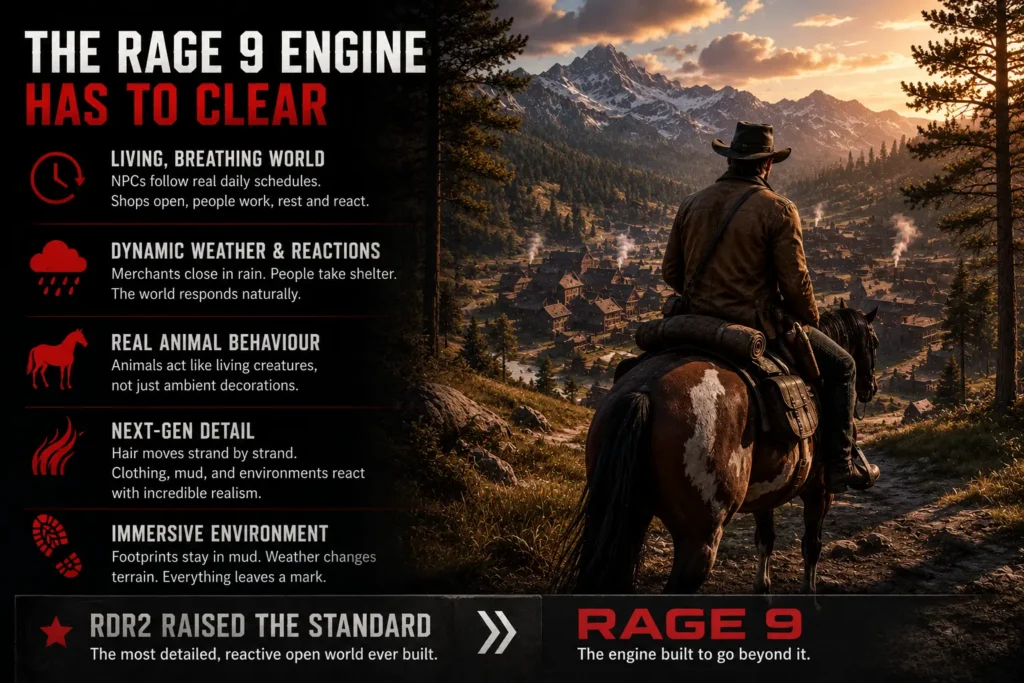
After GTA IV, each Rockstar release tightened the engine further. Red Dead Redemption expanded the physics and world simulation. Max Payne 3 brought proper PC optimisation and DirectX 11 support, which GTA IV never got right. GTA V scaled everything up to a bigger map with an online component running on top.
But Red Dead Redemption 2 in 2018 was a different kind of release. If you played it, you probably remember noticing the world behave in ways other games do not bother with.
NPCs in every town had actual daily schedules. The blacksmith opened his shop, worked, had lunch, worked again, closed up. Not a scripted loop, just how his day was coded to run. Merchants shut down in rain. People took shelter. Animals moved like animals rather than ambient decorations.
Hair moved strand by strand. Mud left footprints that accumulated in grooves. Weather transitions took time and changed how the terrain felt to cross.
The gap between RDR2 and every other open-world game at the time was large enough that many people assumed this was roughly the ceiling for what these games could do technically.
The RAGE 9 engine is Rockstar’s answer to that assumption.
Also Read: Will GTA 6 Support Ray Tracing and 60FPS?
What the RAGE 9 Engine Is Actually Expected to Do in GTA VI?
This is what most articles about the GTA 6 engine skip entirely. The history is covered everywhere. What the RAGE 9 engine actually does differently is where things get interesting.
Based on community leaks, Rockstar patent filings, and technical reporting from outlets that have studied the available documentation, here is what the RAGE 9 engine is expected to introduce.
Must Read: GTA 6 Police AI: How It Could Fix Everything GTA 5 Got Wrong
Water That Actually Behaves Like Water
Every open-world game including RDR2 fakes water. A mesh surface with animated texture layers on top creates the visual impression of movement. From the right angle at the right distance it reads as water. It is not physics, it is a convincing illustration of physics.
The RAGE 9 engine is expected to simulate water as a genuine physical volume using Fast Fourier Transforms, a mathematical approach previously only viable in film CGI because of the processing power it demands.
Ocean waves would respond to actual wind direction and speed. Water would flow around obstacles it encounters rather than passing through them. Coastal areas would change during storms, not just look stormier.
Think about Vice City, a Miami-inspired coastal city that will almost definitely feature hurricanes. In previous GTA games a hurricane changed the sky and added wind audio.
In GTA VI, if the RAGE 9 engine delivers what the leaks describe, a hurricane would generate real storm surges, flood low-lying roads, and make the shoreline physically different than it was an hour earlier.
That is not a visual upgrade. That is a different kind of game world.
Read More: GTA 6 Japan PS5 Physical Edition Has a Download Code Expiry- Here’s Why
Lighting That Reacts to Every Surface
GTA VI is expected to be the first title in the series to use a fully Physically Based Rendering pipeline for lighting. Every surface in the game would carry actual optical properties: roughness, reflectivity, translucency. Light would interact with those properties rather than being pre-baked into textures during production.
Paired with a hybrid ray-traced global illumination system, neon signs would reflect accurately in puddles and on car hoods, headlights would illuminate the actual surface they hit, and interiors would be lit by light coming through windows rather than a separate indoor rig running independently.
Vice City at night with Miami neon everywhere and wet streets after a storm is exactly the environment this kind of lighting was made for. Every version of the RAGE engine has been working toward that scene looking like you are standing there in person. From what the leaks describe, RAGE 9 is the version that gets there.
Check Now: Will GTA 6 Online Be Free to Play?
Characters That Actually Touch the Ground

A Rockstar patent filing called “System and Method for Runtime Retargeting” describes a system that addresses something every open-world game quietly struggles with: feet floating slightly above uneven ground, hands clipping into surfaces they should be resting on.
The system recalculates the animation skeleton in real time using inverse kinematics based on what the character is actually in contact with.
When Jason rests his arm on a car door, the arm matches the actual geometry of that specific door. When Lucia walks up a broken staircase, her feet land on the steps that are actually there, not a flat approximation of where steps might be.
You would never notice this consciously while playing. But you feel it when it is missing. It is what separates a character who inhabits a world from one who is layered on top of it.
More Buildings You Can Walk Into
One of the more interesting patent filings describes a system for generating building interiors without hand-building each one individually. Buildings get tagged with descriptors: “dilapidated,” “modern,” “commercial.” The RAGE 9 engine pulls from a library of modular components and assembles a plausible interior based on those tags.
This is how GTA VI could have a far larger number of enterable buildings than previous titles without Rockstar spending years modelling individual kitchens.
The system also handles persistence in a smart way: if you move something inside a room, leave, and come back, the engine stores only the original generation seed plus the specific change. The room is exactly as you left it without keeping the full room state in memory.
If that works at the scale of an entire city, exploration in GTA VI means something different than it has before.
Read More: GTA 6 File Size: How Much Storage Do You Need?
NPCs With Actual Personalities
Patent US 11,684,855 B2 describes an NPC system that assigns individual variables to every character: aggression level, patience threshold, alertness rating. The patent uses traffic AI as its main example.
If you cut someone off, their reaction comes from their own trait values rather than a shared pool of responses. A patient driver brakes and forgets about it. An aggressive one follows. A nervous one hesitates.
It extends what Euphoria introduced in GTA IV, but across an entire city population rather than just physics-based character reactions. Vice City would not just have more people in it. It would have different kinds of people in it.
RAGE Engine History: Every Version at a Glance
| Game | What the RAGE Engine Added | Year |
| Rockstar Table Tennis | First public RAGE build, physics and animation proof of concept | 2006 |
| GTA IV | Euphoria procedural character physics, full open-world city simulation | 2008 |
| Red Dead Redemption | Expanded outdoor world streaming, improved NPC AI | 2010 |
| Max Payne 3 | DirectX 11 support, proper PC optimisation, stereoscopic 3D | 2012 |
| GTA V | Ambient occlusion, improved lighting and particle systems, larger world scale | 2013 |
| Red Dead Redemption 2 | Vulkan and DX12, volumetric weather, NPC daily routines, individual fur and cloth simulation | 2018 |
| GTA VI* | Physically simulated water, PBR lighting, Runtime Retargeting, procedural interiors, individual NPC traits (based on leaks and patent filings) | November 2026 |
Note: The version informally called “RAGE 9” by the community refers to the GTA VI build. Rockstar has not confirmed this name or the specific features above officially.
Will the RAGE 9 Engine Actually Make GTA VI Feel Different?
Yes. But not in the way most people expect.
Nobody is going to boot up GTA VI, look at the water, and think “wow, Fast Fourier Transform simulation.” What they are going to do is drive through a storm and notice the car handling differently. Walk into a building they assumed was locked. Watch an NPC they just cut off follow them for two blocks because that is apparently just who that person is.
Those moments do not come from better graphics. They come from systems that make the world behave more like a real place and less like a set designed for you to shoot things in.
That street corner in Liberty City in 2008 was the first time I felt that in a GTA game. A city doing its thing with or without me. If the RAGE 9 engine delivers even half of what the patents and leaks point to, GTA VI is going to have a lot more of those moments.
And knowing Rockstar, they have been sitting on this for a while.
You May Also Like: GTA VI Voice Actors: Rumors, Clues & What Rockstar Won’t Tell Us
FAQs
GTA VI runs on the RAGE engine (Rockstar Advanced Game Engine), which Rockstar has developed in-house since 2006. The specific version powering GTA VI is called the RAGE 9 engine by the community, following the pattern of RAGE 7 for GTA V and RAGE 8 for Red Dead Redemption 2. Rockstar has not officially confirmed the version number.
No. Rockstar has not named the engine version used in GTA VI or released technical specifications. RAGE 9 is a community label based on the numbering pattern from previous titles. The features attributed to it come from patent filings and reporting by outlets including Rockstar Mag, not from Rockstar directly.
RAGE 8 powered Red Dead Redemption 2 and introduced volumetric weather, NPC daily routine simulation, Vulkan and DirectX 12 support, and individual fur and cloth physics. The RAGE 9 engine is expected to go further with physically simulated water using FFT rather than mesh textures, a full PBR lighting pipeline with ray-traced global illumination, Runtime Retargeting for accurate character contact with surfaces, and a procedural interior generation system.
Yes, and noticeably so. Real-time fluid dynamics, ray-traced lighting, and city-scale NPC trait simulation all push both CPU and GPU hard. Community estimates put GTA VI on PC firmly in mid-to-high-end hardware territory for stable framerates. See our GTA VI PC system requirements guide for current estimates.
Yes. After EA acquired Criterion Software in 2004 and took ownership of RenderWare, the engine behind GTA III, Vice City, and San Andreas, Rockstar formed the RAGE Technology Group and built their own engine from the ground up. The first game to ship on the RAGE engine was Rockstar Games Presents Table Tennis in 2006.
RAGE was built around the exact kind of simulation Rockstar makes. Unreal Engine handles a wide range of game types well, but it is not designed for simulating thousands of NPCs with individual daily routines, city-scale physics interactions, and the open-world streaming that GTA and Red Dead require. Rockstar would need to build most of those systems themselves on top of Unreal anyway. At that point, maintaining an engine they fully control makes more practical sense.
Found an error or have a tip? Reach us through the contact page. Meanwhile, check how your setup holds up in our GTA 6 system requirements breakdown. We also cover every new trailer, leak, and Rockstar update on our YouTube channel the moment they drop, so hit subscribe if you do not want to miss anything before launch.